About
Alan Stivell was born on January 6, 1944, in Riom, Auvergne, during World War II. His father, Georges Cochevelou, of Cornish (Gourin) and Vannetais (Pontivy) Breton descent, had lived in Paris after World War I. His mother, Fanny, whose parents had diverse roots (including Russian and French), embraced her husband’s…
Alan Stivell was born on January 6, 1944, in Riom, Auvergne, during World War II. His father, Georges Cochevelou, of Cornish (Gourin) and Vannetais (Pontivy) Breton descent, had lived in Paris after World War I. His mother, Fanny, whose parents had diverse roots (including Russian and French), embraced her husband’s Breton identity. Because of the war, the family moved frequently: one brother was born in Paris, another in Épinal, and Alan himself in Riom. He therefore had no particular ties to Auvergne.
After the Liberation, instead of returning to Brittany, the family settled in Paris within the Breton diaspora. A visit to relatives in La Trinité-sur-Mer proved decisive: at the age of five, discovering his father’s homeland deeply moved him. Around the same time, he began studying piano and met composer Paul Le Flem.
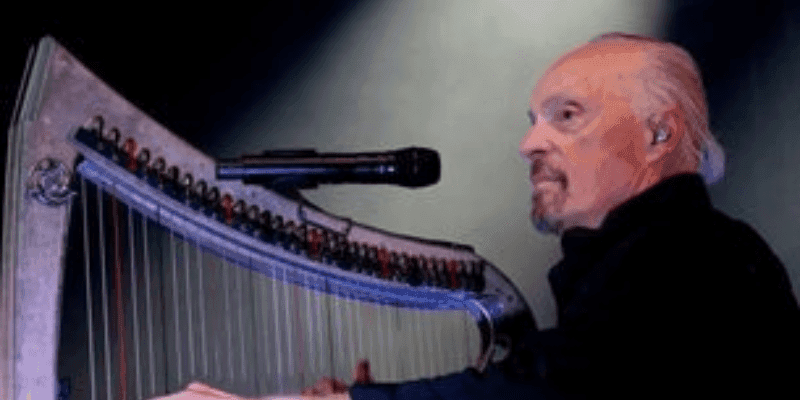
In 1952, his two brothers joined the Breton scouting movement Bleimor, while his father built the first modern Breton harp. Immersed in a strongly Breton cultural atmosphere, Alan took his first harp lessons in April 1953—marking the beginning of a prestigious artistic path. In November of that year, at the Maison de la Bretagne in Paris, the public rediscovered the Celtic harp after centuries of neglect, captivated by the nine-year-old performing Pedenn evit Breizh.
From the early 1950s (from age nine), his recitals stirred audiences at UNESCO, Vannes Cathedral, and the Olympia in Paris, helping to revive the Celtic harp. Deeply passionate about Celtic civilization in all its aspects, he would conceptualize, modernize, and popularize its music.
As early as 1958, he designed the first electric harps and began sketching a symphony (though he chose not to attend the Conservatoire). He made his first recordings—Musique gaélique and Telenn geltiek—and soon developed the idea of Celtic rock. A member of the Bleimor scouts, he acquired the Breton language (passing the Trec’h kentañ exam), immersed himself in traditional music and dance, and graduated from the College of Piping in Scotland. He led the Bleimor bagad to the title of Champion of Brittany in 1966 and twice more, also winning duo championships at Gourin (1966, 1968, 1969).
In 1966, he began singing publicly at the American Center in Paris, Chez Michou in Quimper, and in Italy—marking the true start of his professional career. In 1967, he signed his first international contract with Philips-Fontana (now Universal). In 1968, he was invited by the Moody Blues to perform at London’s Queen Elizabeth Hall. That same year, he met Marie-José, his lifelong companion.
After releasing the single Brocéliande – Son ar chistr in July 1970 (a song widely covered worldwide), his album Reflets launched his conquest of a broader audience. A manifesto of musical fusion, it anticipated what would later be called “world music.” His third album, Renaissance de la harpe celtique (1971), inspired thousands of harpists worldwide and was nominated for a Grammy Award; it also received the Grand Prix Charles Cros (and in 2019, the In Honorem award for his lifetime achievement).
His rock-Breton fusion piece Pop-Plinn, followed by the legendary February 1972 concert and live album À l’Olympia (two million copies sold), sparked the “Stivell phenomenon,” transforming Brittany’s image. From 1973 onward, his international career expanded across Europe, America, and Australia, performing in major venues and rock festivals.
He later produced his own records, including Keltia III and Live à Dublin. Notable works followed: Trema’n Inis (dedicated to Breton poets), Before Landing, Journée à la maison, and his Symphonie celtique (1979–80), often performed at the Festival Interceltique de Lorient and prestigious venues such as London’s Royal Festival Hall and Dublin’s Olympia.
Though uncomfortable with “star” status, he continued to innovate throughout the 1980s and beyond. His album Harpes du Nouvel Âge received an Indie Award in the United States. In 1993, Again (featuring Kate Bush) and its tour were a major success. He was awarded the Collar of the Order of the Ermine in 1994.
He continued collaborating internationally (Brian Boru, 1 Douar with Youssou N’Dour, Jim Kerr, Paddy Moloney, John Cale). In 2000, an asteroid was named after him by Czech astronomer Miloš Tichý.
The 21st century brought anniversary releases (Au-delà des mots), books (Telenn, la harpe bretonne), the avant-garde album Explore, and Emerald (2009). He became honorary president of the Cultural Council of Brittany and was promoted to Commander of Arts and Letters in 2012. Later works include AMzer (2015), Human-Kelt (2018, featuring Andrea Corr, Francis Cabrel, Bob Geldof, Yann Tiersen, and others), his autobiography Stivell par Alan, and the symphonic live double album Liberté-Roazhon (2024).
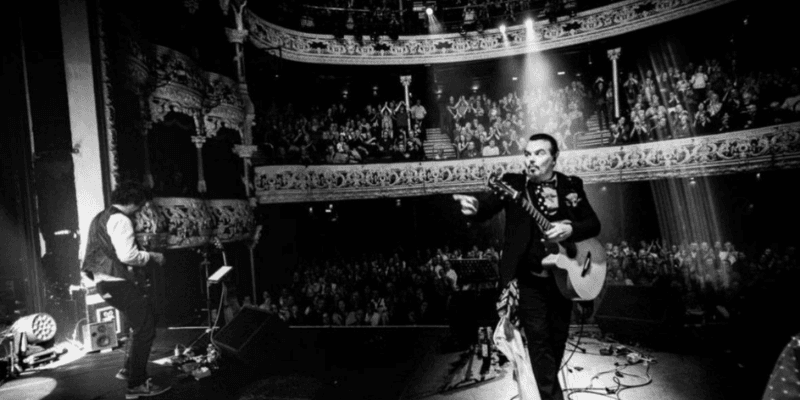
His concerts—whether electro-world-rock, symphonic (notably with the Orchestre National de Bretagne), or intimate performances in churches—reveal multiple artistic facets. Recent tours include Cœur & Âme / Kalon hag Ene and the Liberté Tour, following the unveiling of a statue in his honor in Carhaix.
Throughout his life, Alan Stivell has been driven by curiosity, innovation, and cultural cross-fertilization, while remaining deeply rooted in Breton and Celtic heritage. A pioneer of folk-rock, ambient, and especially world music (which he theorized as early as 1970), he has consistently advocated a global music that preserves human diversity.
To date, he remains the only Breton artist whose entire body of work, centered on Breton culture, has achieved such significant international impact.