Rarely seen revolutionary artefacts to go on display at The Little Museum of Dublin
- Tue, 7 Apr 2026
The Little Museum of Dublin has announced a major new partnership with the Military Archives that will bring a remarkable collection of rarely seen, historically significant artefacts into public view for the next five years.
Most of the objects are drawn from the Brother Allen Collection, which was donated to the Edmund Rice Trust and presented to the Military Archives in 2016 to commemorate the centenary of the Easter Rising. Now a decade later, these deeply personal and nationally important items will be displayed in the heart of Dublin from today, Thursday the 26th March, offering visitors to the museum a timely, rare and intimate insight into the lives of those who shaped Ireland’s revolutionary period.

Highlights from the collection include:
-
The brown leather holster allegedly worn by Michael Collins when he was killed at Béal na Bláth, part of the military equipment belonging to the Commander-in-Chief of the National Army.
-
A handwritten letter from Patrick Pearse to Seán T. Ó Ceallaigh (later president of Ireland) on Easter Weekend (dated 22-4-1916), enquiring whether he could put him and his brother, Willie Pearse, up the Saturday night before the Easter rebellion.
-
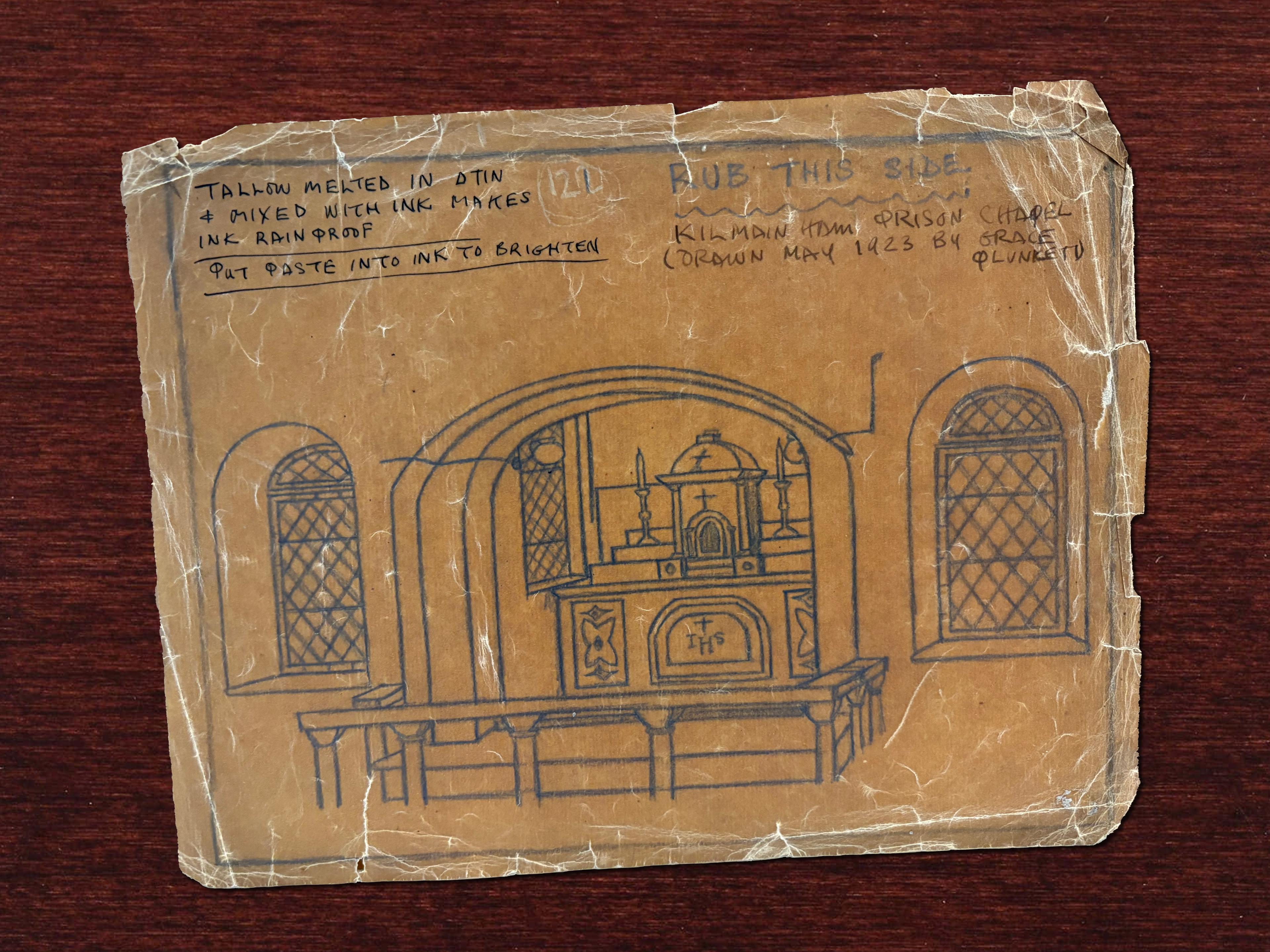
A delicate sketch of Kilmainham Prison Chapel by Grace Gifford, the chapel where she married Joseph Mary Plunkett before his execution. This was later immortalised in the song ‘Grace’.
-
A handwritten dispatch from Seán MacDiarmada, sent from the General Post Office (GPO) on the first day of the Easter Rising, 1916, carried by Seán T. Ó Ceallaigh.
-
A Macramé bag made by Peadar Kearney, author of ‘A Soldier’s Song’ (‘Amhrán na bhFiann’), while serving a sentence of internment in Ballykinlar camp.
-
A silk thread scapular worn by Countess Markievicz while in prison.
-
A Bamba cigarette found in the pocket of William J. Pearse after his execution on May 4th, 1916, in Kilmainham Gaol.
-
Pink felt infant shoes made by Kathleen Clarke, widow of proclamation signatory Tom Clarke, while she was imprisoned in Holloway Prison, 1918.
-
A letter by Dr Kathleen Lynn which she wrote from Mountjoy Prison to the deputy adjutant general, Parkgate, dated 26th June 1916, requesting return of her belongings including medical equipment and a fur coat.
-
A ‘Bloody Sunday’ ticket, for the challenge match of Dublin Vs. Tipperary at Croke Park, Sunday 21st November 1920.

Speaking on the new collection, Daryl Hendley Rooney, Curator of The Little Museum of Dublin, said “We are deeply honoured to share these remarkable artefacts with the public. Each object tells a profoundly human story of courage, sacrifice and resilience, and together they bring us closer to the lived experience of Ireland’s revolutionary generation. It is a privilege to work with the Military Archives to ensure these personal pieces of our national history can be seen, remembered and understood by all.”
These artefacts form a vivid and moving portrait of Ireland’s struggle for independence, revealing the private lives, relationships, and resilience behind well-known historical events. The partnership reflects The Little Museum of Dublin’s commitment to making national history tangible and accessible, while highlighting the vital preservation work of the Military Archives.
Speaking on the partnership, Commandant Daniel Ayiotis, Director of the Military Archives, said today “As both the director of the Military Archives and a born and bred Dubliner, I’m excited and proud that we have partnered with the Little Museum of Dublin. While our most prominent role as an institution is providing access to documentary material, this collaboration gives us the opportunity to share with the public some of our significant collection of historical artefacts in a museum that embodies the unique character of Dublin and tells the stories of the city in a way that educates, advocates, informs, enlightens and entertains.”
These historically significant objects will go on display from today, Thursday, 26 March, ahead of Easter, offering visitors a timely opportunity to reflect on this pivotal moment in Ireland’s history.
For more information and tickets, please visit www.littlemuseum.ie.
Instagram – @littlemuseumdub